
Practice and service in the Reiki tradition means a daily discipline of precepts and self-treatment, a set of initiations that mark your level, and — in the older Japanese framing — an obligation to work on others, often without charge. The tradition holds that the capacity to channel what practitioners call universal life energy is conferred in initiation rather than learned from a book, and that its proper use is service. Everything below is what the tradition claims and what practitioners report, not a medical claim about the body.
What Usui actually established, and why the history changes how you practise
Usui Reiki Ryōhō was founded in March 1922, when Mikao Usui established his spiritual healing system after a retreat and enlightenment experience on Mount Kurama near Kyoto; organized teaching and initiation lineages grew from that point. Usui lived from 1865 to 1926, so the whole of the original system's development sits inside roughly four years of his life. That compression matters practically: what you receive in a modern class is not a single unchanged transmission but a short, intense, quickly transmitted body of practice that was reorganised almost immediately after his death.
The historical record is thin and specific. Reconstructions of early Usui Reiki rest on a small set of primary documents: the 1927 Usui Memorial Stone inscription, a 1904 curriculum vitae of Usui, the 1928 account by Okuna, and the oral and written narrative transmitted by Hawayo Takata in the 1970s. If you want to know whether a particular teaching is old or recent, those are the documents to check against, and anyone teaching Reiki who cannot tell you which of them a claim comes from is usually repeating a Western-layer addition.
The tradition holds that Usui Reiki Ryōhō is a spiritual discipline with precepts, levels of initiation, and hand positions for treatment, transmitted to students in Japan and later adapted in the West. The adaptation is the fault line. Chujiro Hayashi, a physician who studied under Usui, systematised the practice into a clinical-style form — treatments given as structured sessions, with a practitioner working through set hand positions on a clothed recipient — and it was through Hayashi that Hawayo Takata received the tradition and carried it to Western countries. Almost every Reiki lineage you can trace in the United States runs through Takata, which means the clinical, session-based, paid-treatment model most Americans meet is a Hayashi-line inheritance rather than the whole of what Usui taught.
The cost of caring about this is real: it makes some popular teachings awkward. The cost of ignoring it is that you cannot tell a lineage claim from a marketing claim. In practice, a teacher who can name the Usui Memorial Stone and explain what Takata's narrative did and did not preserve is a better bet than one who recites an unbroken master-to-master chain back to a ninth-century monk.
Precepts before hands: what daily practice actually looks like
The daily practice in the Usui system is the precepts and self-treatment, in that order of importance, and most students who quit do so because they were taught the hand positions and never given a workable precept practice. The tradition's precepts are recited morning and evening — a short set of commitments, traditionally repeated aloud or silently on rising and before sleep. The recitation takes a couple of minutes. Self-treatment, hands laid on your own body in a fixed sequence of positions, commonly runs longer, and teachers differ on whether it is a fixed daily obligation or something you do when you feel the need.
What practitioners describe is not dramatic. The usual report is that the precepts are the part that changes how a day goes, and the hands-on self-treatment is the part that makes the practice feel like a practice rather than an intention. Some describe feeling warmth or heaviness under the hands; others feel nothing and continue anyway, because the tradition does not make sensation the measure of whether it is working. Treat any teacher who promises you a specific physical or emotional result from a set number of days of self-treatment as selling something the tradition does not promise.
Initiation is the structural fact underneath all of this. In Usui Reiki Ryōhō the levels are conferred, not earned by study — a teacher initiates a student, and the tradition holds that this is what opens the capacity to practise. That is why you cannot meaningfully self-teach from a book, and why the quality of the person doing the initiating matters more than the length of the manual. It also means the levels are not a curriculum with exams; they are markers of transmission, and different lineages divide the work differently. First degree is normally where hand positions and self-treatment sit; the higher levels in most Western lineages involve more precept work and, at the top, the authority to initiate others.
The honest trade-off: daily precept recitation and self-treatment cost you perhaps ten to thirty minutes a day, and the return is not measurable in the way a gym programme is. If you need a practice with visible milestones to sustain it, Reiki's structure — long flat stretches punctuated by initiation — will frustrate you.
What a treatment session involves, and what it does not
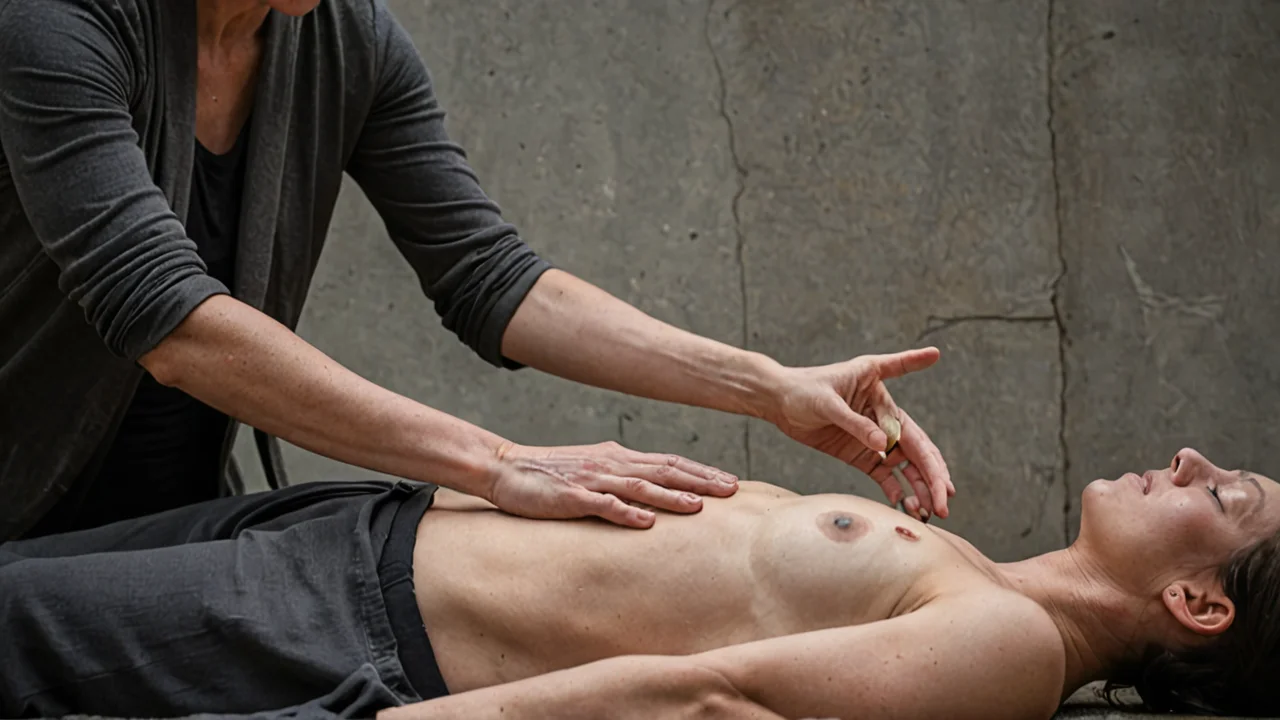
A standard session is given fully clothed, usually on a treatment table, with the recipient lying down and the practitioner moving through a sequence of hand positions — head, face, throat, chest, abdomen, and then the back — resting the hands lightly or holding them just off the body. A full session typically runs somewhere between forty-five minutes and an hour and a half depending on lineage and setting; a self-treatment is shorter. The recipient stays clothed throughout. There is no massage, no manipulation, and no diagnosis.
The tradition holds that the practitioner channels universal life energy and that the energy, not the practitioner's effort, does the work — which is why practitioners are taught to get their own intention out of the way. This is also why Reiki is described as spiritual therapy rather than treatment of a condition. Practitioners report that recipients often become relaxed, sometimes sleepy, occasionally emotional; some report nothing at all and are told that is fine. What the tradition does not claim, and what you should not accept from anyone, is that a session treats, cures, or improves any diagnosed condition. If a practitioner tells you to stop or delay medical care, leave.
Hand positions are the technical core of first-degree practice, and the sequence is what you are actually learning. Getting the positions right matters less than getting the habit of a complete sequence, because skipping the back positions or the abdomen is the most common shortcut and the one teachers notice. If you are receiving sessions rather than giving them, the useful question to ask a practitioner is not "how powerful is it" but which positions they work and how long they hold each — a vague answer usually means an improvised session.
Where this becomes a decision is cost and frequency. Sessions in the West are usually paid, sometimes at rates comparable to a massage; the Japanese framing in which treatment was given as service, without a fee, sits uneasily with that. Neither is dishonest, but you should know which model your practitioner is operating and why.
Service: the part of the practice that is not optional in the older framing
In Usui Reiki Ryōhō as a spiritual discipline, treatment of others is not an advanced add-on — it is the point of having the capacity at all, and the precepts themselves are usually read as committing the practitioner to the wellbeing of others rather than to their own experience. The tradition holds that practice exists to be given away. That is the meaning of service here: hands-on work for other people, and in the older Japanese setting often for people who could not pay for it.
In practice, service takes a few recognisable forms. The most common in the West is treating family and friends at no charge, usually informally and often briefly. The next is volunteering — hospice settings, community clinics, and informal treatment circles where practitioners give sessions to people who would not otherwise receive one. The third, and the one most practitioners find hardest to sustain, is treating people you do not like or whose situation is distressing, which is where the precepts do their actual work.
The honest trade-off is time and boundaries. Service given badly — treating someone who has not consented because you think they need it, or absorbing a distressed person's situation as your own responsibility — is the most common way practitioners burn out. The tradition's own safeguard is the precept work, not a technique. Practitioners who last tend to have a fixed commitment (a regular volunteering slot, a set number of sessions a month) rather than an open-ended willingness to be available. What they report is that the service is what keeps the practice from becoming self-absorbed; what they also report is that it is the first thing dropped when life gets busy, and that dropping it is usually when the practice starts to feel pointless.
Which lineage and which level, and how to judge a teacher
Choose your teacher by lineage transparency and by whether they teach the precepts as practice or as decoration. Because almost every Western lineage runs through Takata, the meaningful differences are in what a given line preserved: whether precept recitation is a daily instruction or a mention in the manual, whether self-treatment is taught as a sequence, whether service is framed as an expectation or as a nice idea, and how the levels are structured. A teacher who can describe their own line and where its emphases came from is a teacher you can work with.
What to check before you pay for first degree:
- Whether the teacher names the historical sources — the Usui Memorial Stone, Usui's curriculum vitae, the 1928 Okuna account, Takata's narrative — or substitutes legend for history.
- Whether self-treatment and precept recitation are taught as daily practice with a concrete sequence, not as suggestions.
- Whether the class includes supervised hands-on practice on other students, since hand positions are learned by doing and not by watching.
- Whether the teacher is clear that Reiki is a spiritual practice and not a treatment for medical conditions, and whether they say so unprompted.
- Whether there is any ongoing contact after the class — a practice group, a check-in, a way to ask questions once you are working alone.
The trade-off in level-chasing is straightforward. Taking second degree or master level early gets you a certificate and, in many lineages, the authority to initiate others, but it does not get you the years of daily precept practice and hands-on hours that make the transmission mean something. The tradition's own logic — capacity conferred, then exercised — argues for sitting at first degree long enough to have a practice before you buy the next level. Reiki master training is not a qualification for anything; it is a commitment to teach and initiate, and taking it without a practice to teach from is the most common expensive mistake in the Western Reiki world.
Where the tradition's other concepts fit, and where the practice stops
Reiki's own map of the person is minimal, but practitioners often borrow from neighbouring traditions, and Ajna is the most commonly imported term. Standard descriptions in Hindu yogic teachings place Ajna as the sixth primary chakra in the subtle body, translated as "authority" or "command" and commonly called the brow or third eye chakra, said to be situated in the centre of the forehead between the eyebrows and associated with intuition and intellect. In Reiki practice, hand positions on the head and face are sometimes explained by reference to Ajna; in jyotish and the yogic traditions the chakra is held to shape intuition and intellect, but that is a claim from those traditions, not from Usui Reiki Ryōhō. If a teacher presents chakra theory as the original Reiki framework, they are blending systems, which is common and not dishonest — but you should know it is a blend.
The limit of the whole subject is worth stating plainly. Reiki is a spiritual practice with a documented history, a defined structure of precepts and initiation, and a service orientation that the tradition holds to be its purpose. It is not a medical treatment, and nothing in the tradition's own sources makes it one. What practitioners report — relaxation, a sense of steadiness, a changed relationship to their own day — is reported experience, not evidence of physiological effect, and any practitioner who blurs that line is not representing the tradition accurately.
If you take one thing from the structure: the order is precepts, then self-treatment, then initiation into giving, then service. Practitioners who reverse it — collecting levels first and building a practice later — usually end up with certificates and no practice. The ones who last start with the two minutes of precepts and the daily hands-on work, take first degree when they are ready to give sessions away, and measure their progress by how consistently they show up for other people rather than by how many levels they hold.